Cloud Revolution in Delivery Management
At Sci-Log, we’ve seen the good, the bad, and the ugly of last century’s routing, distribution network design and transportation planning software. Based on those first-hand experiences, our team developed a modern, state-of-the-art SaaS platform that delivers business consistency and control, and has ignited a revolution in delivery management.
As the only true cloud routing and scheduling solution, we leverage a parallel computing architecture, automated workflow orchestration, an enterprise design, contemporary user interface, advanced optimization algorithms, and integration-friendly web services components as the foundation of the Sci-Log system. We proudly supply:
- Optimized and operationally functional routes that require minimal user intervention.
- The only route optimization software that integrates delivery strategy and distribution network design, automated what-if simulations, and route planning operations.
- Unmatched cloud computing horsepower that significantly compresses timeframes for daily route planning and what-if analysis.
- The industry’s most enterprise-savvy solution that provides centralized visibility and control across all regions and distribution centers, for a variety of users including customer support, finance and sales.
But don’t take our word for it, check out the customers who have already joined the revolution.
Moving to the cloud with Sci-Log means continuous improvement via automatic, painless updates, so your team always has the latest software and most recent maps — avoiding IT headaches and costly maintenance fees. And, our supply chain experts provide even more expertise to extend your distribution team.
Check out our SaaS solutions designed to support a wide variety of needs across a multitude of industries:
Dynamic Routing and Scheduling
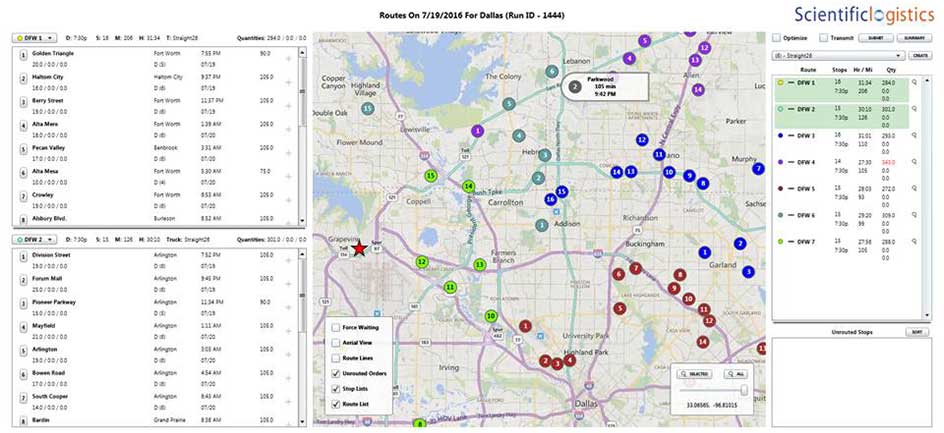
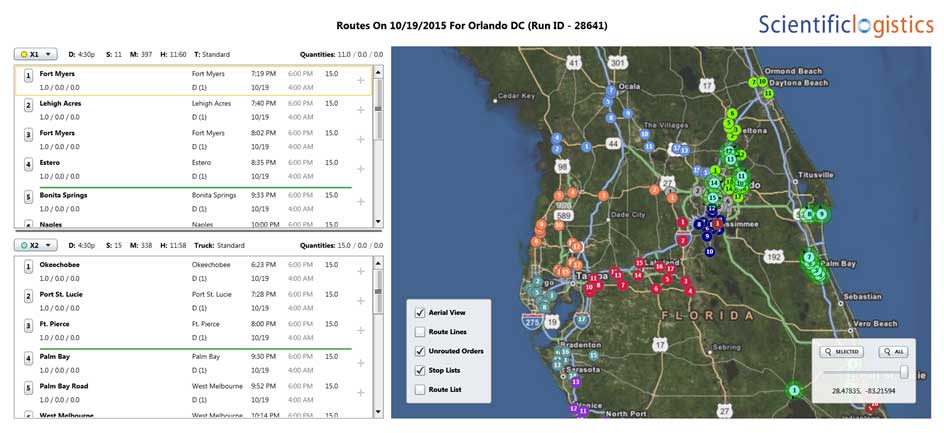
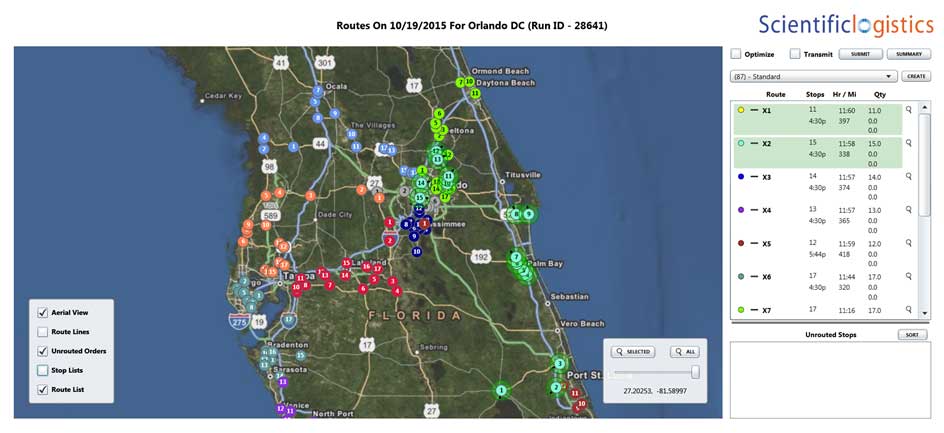
Sci-Log helps significantly reduce transportation costs by dynamically adjusting or “flexing” routes each day. Given a set of customers and associated order quantities, the Sci-Log solution automatically finds the lowest cost plan while respecting all business rules and constraints. The Sci-Log solution optimizes a variety of multi-stop route applications, including delivery routes, pickup routes, and mixed pickup and delivery routes. These applications are characterized by truck routes that visit multiple stops and by variability in customers and customer order quantities.
Fixed Route Design and Tuning
The Sci-Log solution designs the optimal set of fixed routes – then, just as importantly, we keep tuning the fixed routes as customers are won or lost or other changes occur. The Sci-Log solution can also be used in a hybrid fashion combining the operational consistency of fixed routes with the cost reductions of dynamic routes. Here, certain aspects of routes are “locked” for consistency (such as key customers to certain drivers, or certain route sequences), but other rules and decisions are left open for more flexible route optimization. Fixed route design is characterized by truck routes that visit multiple stops, and customer order patterns or service patterns are relatively constant, or high route consistency is required even in the face of order variability. Thus the same fixed routes can be run each day or period.